
The Architectural Revolution: Why the Integrated Bracelet Dominates Modern Horology
In contemporary haute horlogerie, no category commands greater collector passion, market liquidity, and cultural prestige than the integrated bracelet luxury sports watch. Characterized by an uninterrupted architectural silhouette where the case geometry flows seamlessly into the bracelet links without traditional protruding lugs or generic spring bar gaps, these timepieces represent the ultimate synthesis of industrial design and mechanical mastery.
What began in 1972 as an audacious gamble by Audemars Piguet has transcended temporary fashion to become the universal blueprint of luxury lifestyle timepieces. Today, discerning collectors demand watches that transition effortlessly from executive boardrooms to yacht decks—robust enough for daily recreation yet executed with the hand-finished fineness of traditional high horology.
The Genesis: Gérald Genta and the 1970s Steel Renaissance
To understand the dominance of the integrated bracelet, one must revisit the horological crisis of the early 1970s. As the quartz revolution threatened mechanical watchmaking, luxury was exclusively equated with precious yellow gold dress watches. In 1972, legendary designer Gérald Genta shattered convention overnight:
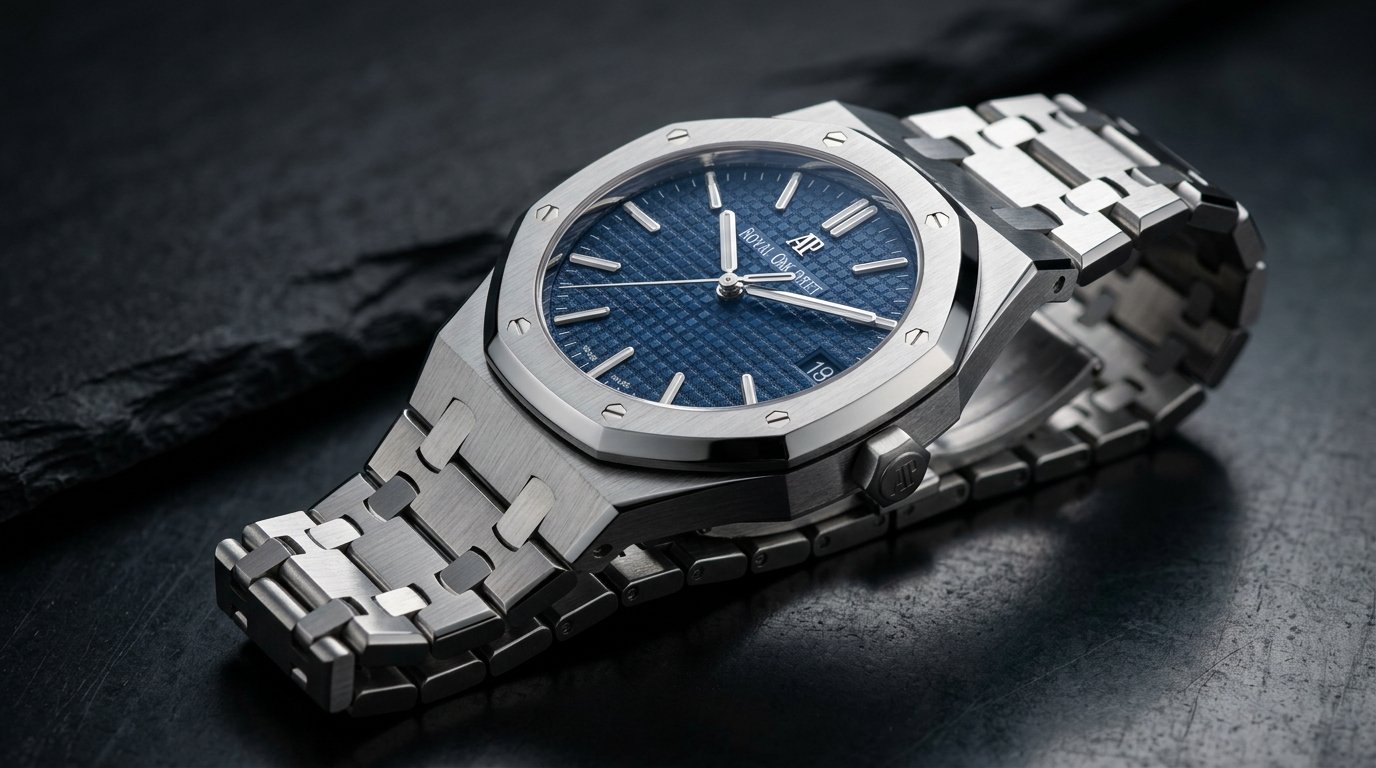
- 1972 — Audemars Piguet Royal Oak (Ref. 5402ST): Designed in a single night prior to the Basel Fair, Genta conceived a luxury steel watch priced higher than conventional gold timepieces. Its octagonal bezel secured by eight visible hexagonal screws, exposed water-resistance gasket, and complex tapering steel bracelet hand-finished with alternating satin-brushed and mirror-polished facets redefined sports elegance.
- 1976 — Patek Philippe Nautilus (Ref. 3700/1A): Commissioned to create an equally transcendent steel sports icon, Genta looked to maritime portholes, featuring two lateral “ears” and an integrated bracelet renowned for its unmatched supple drape on the wrist.
- 1976 — IWC Ingenieur SL (Ref. 1832): Completing Genta’s holy trilogy of industrial sports design, the “Jumbo” Ingenieur introduced a technical grid dial, screw-down bezel apertures, and an integrated link geometry engineered to withstand extreme magnetic environments.
- 1977 — Vacheron Constantin 222 (by Jörg Hysek): Celebrating the maison’s 222nd anniversary, Hysek penned a scalloped, monobloc tonneau-cased icon that would eventually evolve into the modern Overseas collection.
The Holy Trinity: Apex Integrated Sports Watches
At the pinnacle of the integrated spectrum sit three iconic references that define horological investment and manufacturing excellence:
1. Audemars Piguet Royal Oak ‘Jumbo’ Extra-Thin (Ref. 16202ST)
The purest descendant of Genta’s original vision. Measuring a historically accurate 39mm in diameter and an astonishing 8.1mm in profile, the Ref. 16202 houses the manufacture Calibre 7121 with 55 hours of power reserve. The bracelet remains an unmatched work of metallurgical art: each individual link diminishes in both width and thickness toward the AP folding clasp, with razor-sharp beveled chamfers that catch ambient light with kinetic brilliance.
2. Vacheron Constantin Overseas Automatic (Ref. 4520V)
Widely regarded by seasoned connoisseurs as the most technologically versatile integrated watch in existence. Updated with a refined 41mm case and an ultra-slender profile, the Overseas stands out for its patented tool-free strap interchangeability system. Within five seconds, owners can switch between a Maltese-cross-inspired stainless steel bracelet, an alligator dress strap, and a high-performance textured rubber strap without requiring screwdrivers or tools. Powered by the Geneva Seal-certified Calibre 5100 with twin barrels offering 60 hours of autonomy and a soft-iron antimagnetic casing ring.
3. Patek Philippe Nautilus (Calibre 26-330 S C)
Whether in previous Ref. 5711 iterations or the contemporary precious metal variants (such as the white gold 5811/1G), the Nautilus offers a softer, more organic counterpoint to the sharp industrial angles of the Royal Oak. Its articulated H-links with rounded, mirror-polished central elements hug the wrist with extraordinary ergonomic comfort.
The Modern Contenders: Heavyweight Alternatives Shaping the Market
While the Holy Trinity commands multi-year boutique waitlists, several premier Swiss and German manufactures have developed exceptional integrated sports timepieces that rival or exceed their finishing standards:
Chopard Alpine Eagle 41
Crafted from Chopard’s proprietary Lucent Steel A223—an ethical alloy melted with an 85% recycling rate that delivers 50% greater Vickers hardness than standard 316L steel and exceptional light reflection comparable to white gold. The dial is stamped with a swirling texture evoking the iris of an alpine eagle, while the integrated single-link bracelet features a raised central cap reflecting architectural brutalism at its finest.
Bulgari Octo Finissimo Automatic
A masterclass in Italian architectural geometry and Swiss micro-mechanical record-breaking. At just 5.50mm in total case thickness, the Octo Finissimo features a 110-facet sandblasted titanium or satin-polished steel case. Its wafer-thin integrated bracelet flows effortlessly from the ultra-wide 40mm case, utilizing an integrated micro-rotor Calibre BVL 138 with platinum winding mass.
Girard-Perregaux Laureato 42mm
Dating back to 1975, the Laureato predated the Nautilus and Ingenieur. Featuring an octagonal bezel resting atop a circular plinth and a Clous de Paris hobnail dial, its integrated bracelet features substantial satin-brushed H-shaped links punctuated by domed, polished center links that offer outstanding wrist presence.
IWC Ingenieur Automatic 40
Re-engineered directly from Genta’s 1976 Ingenieur SL blueprint, the modern Ingenieur 40 features functional polygonal bezel screws, an intricate embossed grid dial, and a closed caseback safeguarding a soft-iron inner cage resistant to intense magnetic fields. Its integrated middle link architecture ensures balanced weight distribution.
Integrated Sports Watch Comparison Matrix
| Model & Maison | Case Diameter | Case Thickness | Water Resistance | Proprietary Alloy / Material | Interchangeability System |
|---|---|---|---|---|---|
| Audemars Piguet Royal Oak 16202ST | 39.0 mm | 8.1 mm | 50 m | Hand-Finished Stainless Steel | Fixed Screwed Construction |
| Vacheron Constantin Overseas 4520V | 41.0 mm | 10.7 mm | 150 m | 316L Steel / Soft Iron Inner Ring | Patented Tool-Free Quick-Release (3 Straps Included) |
| Chopard Alpine Eagle 41 | 41.0 mm | 9.7 mm | 100 m | Lucent Steel A223 (Extra Hardness & Luster) | Factory Integrated Bracelet |
| Bulgari Octo Finissimo Auto | 40.0 mm | 5.5 mm | 100 m | Ultra-light Titanium / Satin Steel | Seamless Integrated Folding Clasp |
| Girard-Perregaux Laureato 42 | 42.0 mm | 10.7 mm | 100 m | Brushed & Polished Stainless Steel | Integrated H-Link Construction |
| IWC Ingenieur Automatic 40 | 40.0 mm | 10.8 mm | 100 m | Antimagnetic Shielded Stainless Steel | Closed Middle-Link Articulated Bracelet |
The Buyer’s Guide: 4 Critical Factors Before Purchasing
Acquiring an integrated bracelet sports timepiece involves distinct mechanical and ergonomic considerations that differ fundamentally from traditional strap-mounted watches:
1. The Effective “Lug-to-Lug” Footprint
Because the first link attached to the watch case (frequently referred to as the “end-link” or “male connector”) is often rigid or fixed at an angle, integrated bracelet watches wear substantially larger than their nominal case diameter indicates. For example, a 39mm Royal Oak features an effective rigid span exceeding 48mm across the wrist. Collectors with wrist circumferences under 6.5 inches (16.5 cm) should prioritize references with fully articulating first links or explore 37mm–38mm variants to ensure the bracelet drops straight down without unsightly gaps.
2. The Micro-Adjustment Imperative
Unlike leather or rubber straps that offer infinite pin-buckle tailoring, a metal bracelet expands and contracts relative to body temperature, humidity, and physical exertion. Premium integrated designs incorporate tool-free micro-adjust mechanisms inside the clasp (such as Vacheron Constantin’s 2mm comfort extension or modern diver extension pushers). If a reference lacks micro-adjustment, verify whether 1.5x half-links are available from the manufacturer.
3. Hand-Finishing and Light Dynamics
The true benchmark of high horology in this category lies in the metallurgical transition zones. Inspect the edges where horizontal satin brushing meets polished anglage: the bevels should be perfectly uniform, sharp to the eye yet smooth to the touch, without waviness or soft rounding. In premium pieces, the brushing pattern flows seamlessly across the case, down each individual link, terminating at the clasp.
4. Strap Swapping Versatility
Traditional watches can accept virtually any aftermarket 20mm leather, canvas, or NATO strap. With an integrated timepiece, you are locked into the manufacture’s case interface. If versatility is a key buying criterion, houses offering modular quick-release systems (like the Vacheron Constantin Overseas or Cartier Santos) provide superior daily flexibility over rigid screw-secured bracelets.
Investment Outlook and Secondary Market Liquidity
From an investment and asset preservation standpoint, stainless steel integrated bracelet sports watches remain among the most resilient segments of the secondary market. While the speculative premiums of 2021 have corrected toward sustainable historical averages, references like the Royal Oak 16202ST, Vacheron Overseas 4520V, and vintage Genta-designed icons maintain extraordinary residual value. Their combination of utilitarian durability, brand pedigree, and limited annual production guarantees enduring demand among worldwide collectors.