
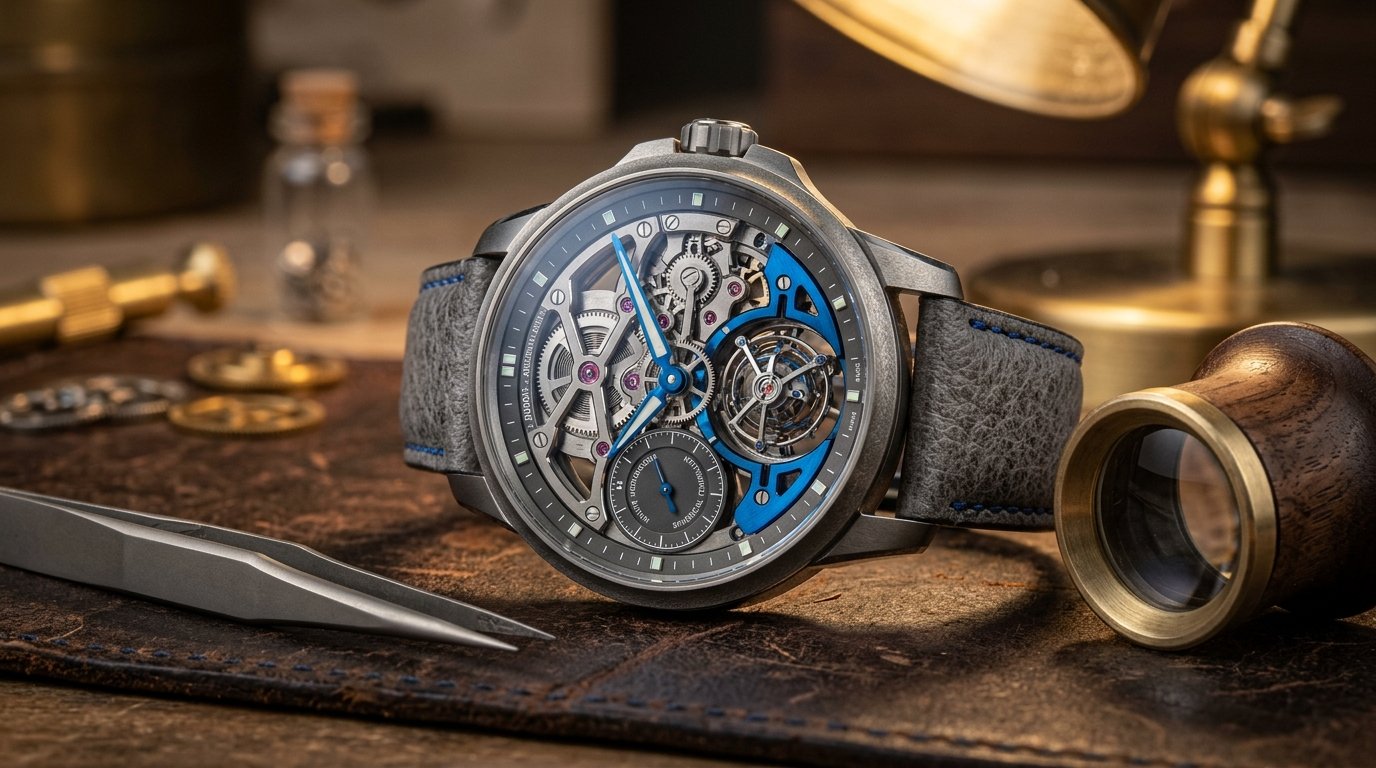
The Great Collector Migration: Why Connoisseurs Are Flocking to Independents
Over the past decade, a quiet revolution has fundamentally remapped the hierarchy of luxury watchmaking. While corporate conglomerates produce hundreds of thousands—or millions—of mass-manufactured luxury timepieces each year, the world’s most discerning collectors and high-net-worth connoisseurs have pivoted decisively toward independent watchmakers.
Driven by an appetite for uncompromising hand-craftsmanship, unconstrained artistic vision, and genuine micro-production, independent haute horlogerie represents the purest expression of mechanical art. Free from quarterly shareholder earnings calls and corporate focus groups, independent master watchmakers dare to build timepieces that corporate boards would deem commercially unviable: kinetic wrist sculptures, astronomical complications with spherical moon phases, and movements decorated with hundreds of hours of manual hand-anglage.
What Defines an “Independent” Watchmaker?
In the lexicon of horology, an independent maison is defined by three fundamental criteria:
- Autonomous Governance: The brand is privately owned and operated by the founding artisans or private horological families, completely free of luxury conglomerate ownership (such as Richemont, LVMH, or the Swatch Group).
- Extreme Scarcity: While industrial luxury brands produce 20,000 to over 1,000,000 watches annually, premier independent ateliers produce anywhere from 15 to 2,500 pieces per year worldwide.
- Artisanal Movement Finishing: Components are finished predominantly by hand using traditional 18th- and 19th-century techniques: mirror black polishing (poli noir), hand-chamfered internal angles (anglage rentrant), circular graining (perlage), and thermal heat-bluing.
The Blue-Chip Titans: Masters of the Modern Renaissance
These benchmark independent maisons have achieved institutional prestige and formidable secondary market value retention:
1. MB&F (Maximilian Büsser & Friends)
Founded in 2005 by former Harry Winston Timepieces managing director Maximilian Büsser, MB&F dismantled the very definition of a wristwatch. Rejecting conventional round cases, MB&F conceptualizes “Horological Machines”—radical, three-dimensional kinetic sculptures inspired by 1970s sci-fi, supersonic aircraft, and organic lifeforms. Simultaneously, their “Legacy Machines” re-imagine what 19th-century horological masters would have created if born today, featuring majestic balance wheels suspended floating above lacquer or enamel dials.
2. De Bethune
Co-founded by master watchmaker Denis Flageollet, De Bethune stands at the intersection of classical 18th-century chronometry and 21st-century aerospace materials science. Celebrated for their signature thermal-blued titanium cases, patented floating lugs that contour dynamically to the wrist, and three-dimensional spherical moon phases accurate to one day every 1,112 years, De Bethune watches represent horological futurism at its absolute zenith.
3. F.P. Journe (Invenit et Fecit)
Francois-Paul Journe’s motto—”Invenit et Fecit” (He invented it and made it)—is etched onto every watch. Journe revolutionized modern chronometry with the Chronomètre à Résonance, harnessing acoustic physical resonance between two balance wheels to achieve peerless timing stability. Journe timepieces are distinguished by their solid 18k rose gold movements, slim case profiles, and classical dial layouts that consistently break auction records worldwide.
4. H. Moser & Cie.
Famous for their minimalist philosophy and satirical horological critiques, H. Moser & Cie. has become a powerhouse of independent elegance. Their signature Concept dials eliminate logos and hour indices altogether, allowing the mesmerizing depth of their fume sunburst gradients to command attention. Technically, Moser is one of the few manufactures in the world that crafts its own balance springs (via sister company Precision Engineering AG) and modular perpetual calendars that can be adjusted forward and backward at any time of day.
The Neo-Classical Purists: Laurent Ferrier & Czapek
For collectors who prioritize serene, discreet sophistication over avant-garde geometry, two houses stand out:
Laurent Ferrier
Founded by a veteran who spent nearly four decades at Patek Philippe, Laurent Ferrier crafts watches designed for the ultimate “stealth wealth” connoisseur. Featuring organic, pebble-smooth cases (the “Galet”), spear-shaped Assegai hands, and micro-rotor movements equipped with natural escapements and double direct-impulse systems, Laurent Ferrier movements showcase internal angles so sharp and gleaming they are revered as the gold standard of hand anglage.
Czapek & Cie.
Revived through a unique crowdfunding collective of horology enthusiasts, Czapek pays tribute to François Czapek, the original 19th-century partner of Antoine Norbert de Patek. With the launch of the Antarctique integrated sports watch featuring the proprietary SXH5 micro-rotor calibre with skeletonized black-ruthenium bridges, Czapek achieved global cult status among modern collectors.
Avant-Garde Disruptors: Ressence & Berneron
Independent horology is also the incubator for radical mechanical disruption:
Ressence (Beyond Traditional Hands)
Founded in Antwerp by industrial designer Benoît Mintiens, Ressence eliminated traditional hands and crowns. Their patented ROCS (Ressence Orbital Convex System) features constantly rotating sub-dials that orbit one another within a curved sapphire dome. In models like the Type 3 and Type 5, the upper chamber is filled with 35.7 ml of surgical-grade oil, creating a zero-refraction, high-contrast display where the dial appears projected onto the sapphire crystal glass.
Berneron (Organic Asymmetry)
Former Breitling designer Sylvain Berneron ignited the collecting world with the Mirage, an extraordinary organic timepiece where neither the case, the dial, nor the movement itself contains a single straight line or symmetrical curve. Even the solid gold movement gears are shaped irregularly to conform to the natural asymmetric contours of the human wrist.
Independent Watchmakers Comparison Matrix
| Manufacture | Annual Production (Approx.) | Core Mechanical Philosophy | Flagship Iconic Reference | Collector Entry Price Range |
|---|---|---|---|---|
| MB&F | ~350 pieces | 3D Kinetic Sculptures & Suspended Balances | Legacy Machine LM101 / HM9 Flow | $60,000 – $250,000+ |
| De Bethune | ~250 pieces | Thermic Blued Titanium & Spherical Moonphase | DB28 ‘Kind of Blue’ / DB25 Starry Varius | $75,000 – $300,000+ |
| F.P. Journe | ~900 pieces | Solid 18k Rose Gold Movements & Acoustic Resonance | Chronomètre Souverain / Résonance | $45,000 – $500,000+ |
| H. Moser & Cie. | ~2,000 pieces | Minimalist Fumé Dials & Reversible Perpetual Calendars | Streamliner Flyback / Endeavour Perpetual | $20,000 – $85,000 |
| Laurent Ferrier | ~250 pieces | Pebble Aesthetics & Benchmark Hand Anglage | Classic Micro-Rotor / Square Sport | $45,000 – $110,000 |
| Czapek & Cie. | ~800 pieces | High-end Micro-Rotors & Openworked Modern Architecture | Antarctique Passage de Drake / Place Vendôme | $22,000 – $70,000 |
| Ressence | ~400 pieces | Crownless Fluid-Filled Planar Orbital Discs (ROCS) | Type 3 Black / Type 1 Round | $18,000 – $45,000 |
The Collector’s Playbook: How to Acquire Independent Timepieces
Navigating the independent watch landscape requires a completely different approach than buying from corporate boutiques:
1. Direct Artisan Relationships
One of the single greatest joys of collecting independents is accessibility. Unlike monolithic brands where the watchmakers are hidden behind corporate marketing walls, independent events (such as Geneva Watch Days or Dubai Watch Week) allow collectors to converse directly with Max Büsser, Denis Flageollet, or Benoît Mintiens over coffee. Cultivating relationships with the founders or visiting their regional retail partners often unlocks allocations for highly coveted limited editions.
2. The Micro-Allocation Waitlist Reality
Because outputs are counted in dozens rather than thousands, production runs are frequently allocated years in advance. Patience is paramount: securing an allocation directly from an independent atelier often requires placing a deposit and waiting 12 to 36 months while the artisans hand-finish each component of your specific watch.
3. Secondary Market Due Diligence
When purchasing independent timepieces on the secondary market or through specialized horological auctions (like Phillips or Christie’s), provenance is critical. Always demand original papers signed by the founding watchmaker, complete archive extracts, and documented service history directly from the manufacture, as third-party watchmakers generally lack the proprietary tooling and specialized lubricants required to service bespoke independent calibres.
Conclusion: The Ultimate Expression of Horological Individuality
As commercial luxury continues its drift toward mass saturation and algorithmic standardization, independent watchmakers stand as the heroic defenders of authentic haute horlogerie. For the true connoisseur, strapping an independent masterpiece to the wrist is not about broadcasting social status—it is a deeply intimate celebration of human artistry, mechanical daring, and timeless individuality.