
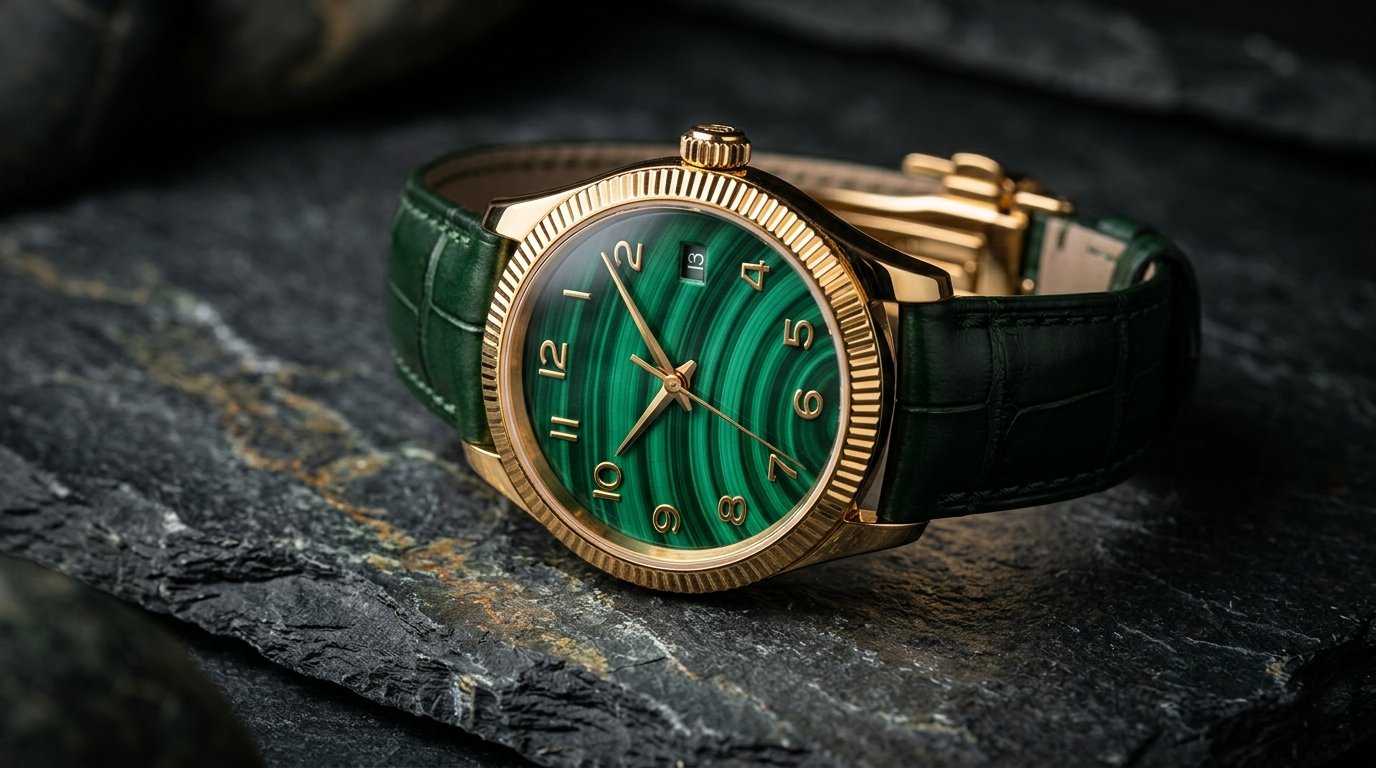
The Rebirth of Geological Horology: Why Stone Dials Are Captivating Collectors
In an era dominated by uniform, mass-produced luxury timepieces, a profound counter-movement has taken hold of high horology: the dramatic resurgence of natural stone and mineral dials. Moving decisively away from standard stamped brass and conventional lacquered surfaces, premier watchmaking maisons are turning to the Earth’s geological mantle and the depths of the cosmos to source raw materials.
From the hypnotic concentric banding of green malachite to the star-flecked celestial blue of lapis lazuli and the stark, deep elegance of black onyx, hardstone dials represent the ultimate convergence of lapidary art and mechanical engineering. Because every geological fissure, crystallization, and mineral inclusion is shaped over millions of years, no two stone dial watches are ever identical. For collectors, owning a stone dial means possessing an unrepeatable natural fingerprint on the wrist.
The Golden Era: A Historical Tribute to the 1960s and 1970s
The contemporary fascination with hardstone dials is deeply rooted in the avant-garde design revolution of the late 1960s and 1970s. During this transformative epoch, legacy houses pushed beyond conservative watchmaking codes:
- Piaget’s Lapidary Supremacy: Under the visionary direction of Valentin Piaget, the maison shocked the Swiss establishment at the 1957 Basel Fair by mastering ultra-thin movements (Calibre 9P), creating the physical clearance required to slice and mount fragile hardstones onto watch faces. Celebrated by style arbiters from Andy Warhol to Jackie Kennedy, Piaget turned hardstone into a symbol of audacious jet-set glamour.
- The Rolex Stella and Exotic Mineral Dial Era: In the 1970s and 1980s, Rolex introduced bespoke exotic dials for the Day-Date “President” and Datejust collections, casing slices of birch, onyx, lapis lazuli, and fossilized stone within solid 18k gold cases. Today, these vintage references rank among the most fiercely contested grails at international auctions. Explore historical milestones in our Rolex Brand History Guide.
The 4 Star Materials Defining the Modern Revival
1. Malachite: The Vibrant Emerald Banding
Composed of basic copper carbonate, malachite is revered for its vivid emerald-green coloration and alternating bands of light and dark forest green. Sourcing uniform, fracture-free malachite specimens requires rigorous gemological grading. When paired with 18k yellow gold or rose gold cases, malachite produces an organic, architectural contrast that captures ambient light with extraordinary depth.
2. Lapis Lazuli: Celestial Majesty
Cherished since Mesopotamian antiquity, lapis lazuli is a semi-precious metamorphic rock predominantly composed of lazurite, calcite, and shimmering specks of golden-yellow pyrite. The most prized lapis dials display a deep, uniform ultramarine blue, creating the optical illusion of a miniature nocturnal galaxy enclosed beneath a sapphire crystal.
3. Black Onyx: Pure Architectural Minimalism
For collectors who favor monochrome severity over ornamental veining, black onyx provides the ultimate minimalist canvas. A micro-crystalline variety of quartz, fine onyx absorbs light to create a pitch-black, mirror-polished void. Maisons frequently omit hour markers and minute tracks altogether on onyx dials, allowing the stark, architectural interplay between the polished gold hands and the ink-black stone to command total focus.
4. Iron Meteorite: Extra-Terrestrial Precision
Sourced from fragments of nickel-iron asteroidal bodies (such as the Gibeon and Muonionalusta meteorites), these dials feature distinct geometric crystal structures known as Widmanstätten patterns. These crystalline ribbons formed over hundreds of millions of years as molten planetary cores cooled in the vacuum of deep space at rates of merely one degree per million years—a physical phenomenon impossible to replicate in any earthly laboratory.
The Lapidary Challenge: Crafting Fragile Slices Under 0.5mm
While the aesthetic allure of hardstone is immediate, the manufacturing attrition rate remains one of the highest in watchmaking:
- Ultra-Thin Precision: To fit between the movement hand-pinion and the crystal, raw minerals must be precision-sliced using specialized diamond-wire saws down to thicknesses between 0.3mm and 0.5mm.
- Fragility and Internal Stresses: Hardstones possess natural cleavages, microscopic fissures, and varying hardness levels on the Mohs scale. Drilling central hand-arbors and date apertures frequently induces catastrophic micro-fractures, with rejection rates often exceeding 50% during production.
- Brass Backing Reinforcement: To withstand the mechanical torque of watch hands and daily shock impacts, master lapidaries adhere the wafer-thin stone slice onto an ultra-thin brass support base before final polishing.
Comparative Analysis: Premier Modern Stone Dial References
| Manufacturer & Model | Stone Material | Case Metal | Case Diameter | Collector Appeal |
|---|---|---|---|---|
| Rolex Day-Date 36 (Ref. 128238) | Green Malachite / Turquoise | 18k Yellow Gold | 36.0 mm | Iconic Heritage & Extreme Liquidity |
| Piaget Polo 79 / Altiplano | Sodalite, Lapis & Malachite | 18k Gold / Platinum | 38.0 mm | Pioneering High-Jewelry Provenance |
| Cartier Santos-Dumont | Black Onyx / Obsidian | Platinum / Rose Gold | 31.4 x 43.5 mm | Sculptural Dandyism & Contrast |
| Rolex Cosmograph Daytona | Gibeon Iron Meteorite | 18k White Gold | 40.0 mm | Celestial Grail Status & Value Retention |
| Omega Speedmaster Grey Side | Seymchan Meteorite | Ceramic / Sedna Gold | 44.25 mm | Space Exploration Synergy |
Collector Care & Maintenance Protocols
Due to the porous and brittle nature of crystalline minerals, owning a hardstone timepiece requires specialized stewardship. Sudden thermal shocks, exposure to chemical solvents, or severe mechanical impacts can compromise the integrity of the dial. When sending your timepiece for mechanical revision, ensure the watchmaker is formally certified in handling delicate dial components. Consult our Watch Care & Maintenance Protocols for comprehensive guidelines.
Investment Potential and Market Outlook
From an asset-preservation perspective, authentic stone dials command substantial premiums over standard production variants. As detailed in our Luxury Watch Investment Guide, scarcity combined with individual uniqueness shields stone dials from the depreciation often seen in generic luxury releases. Discontinued mineral references from the 1970s and modern allocations from top Geneva maisons continue to set benchmark results across leading international auction houses.
Frequently Asked Questions
1. What makes stone dial watches unique compared to traditional dials?
Unlike painted, lacquered, or galvanic metal dials that look identical across production runs, every stone dial is sliced from naturally occurring geological mineral formations or meteorites. Variations in veining, color saturation, and crystalline inclusions guarantee that every single watch is a unique, one-of-a-kind art piece.
2. Are stone watch dials more fragile than standard metal dials?
Yes. Hardstones such as malachite, lapis lazuli, and turquoise are naturally brittle and sensitive to thermal shock and mechanical impacts. However, once securely cased inside a high-end luxury watch equipped with a sapphire crystal and shock-resistant movement mountings, they can endure for generations of daily wear.
3. Which brands are most famous for stone dial timepieces?
Piaget is historically recognized as the pioneer of hardstone dials since the 1960s. Rolex has famously produced exotic mineral dials (including lapis lazuli, onyx, and meteorite) across the Day-Date and Daytona lines, while Cartier, Chopard, and Audemars Piguet have also created legendary stone-dial collector references.
4. Does a stone dial increase the resale value of a luxury watch?
Yes. Watches fitted with original factory stone dials consistently command significant premiums over standard metal dials on the secondary market. Their production numbers are inherently limited by the difficulty of sourcing high-grade mineral specimens and the painstaking lapidary labor required to craft them.
5. Can a damaged stone dial be repaired?
Due to the crystalline structure of minerals, fractured or cracked stone dials generally cannot be seamlessly repaired. In the event of catastrophic damage, the entire stone wafer must typically be replaced by the original manufacturer or an expert lapidary horologist.